Digital Transformation
Load Testing

Volatile, uncertain, complex, ambiguous, fragile, anxious, nonlinear, and incomprehensible… These are the adjectives used to describe the world in recent years, summarized by the terms “VUCA” and “BANI.” But regardless of how you perceive the world today, one thing seems undeniable: change is happening faster and faster. And to adapt to them with as little disruption as possible, companies can implement change management projects.
It is a discipline that focuses on the human dimension of change within an organizational context. Through change management, it is possible to establish a structured process to prepare and support people who are undergoing a transformation process within organizations, thereby increasing their willingness and readiness for change.
These two capabilities become even more critical in situations such as the one we are currently experiencing: profound transformations across all organizations driven by new technology. At other points in history, it was electricity, internal combustion engines, digital computing, or the Internet. Today, artificial intelligence is the transformative force—a technology that prompts us to reflect precisely on the human dimension within organizations.
In this article, we will explore change management as a discipline, highlighting the benefits it offers during times of inevitable transformation.
Although it may sound like a contradiction, change is a process that is constantly taking place, both on an individual and a business level. We change almost daily in our work practices or in the way we lead our personal lives.
The changes we make every day are usually small: we learn to use a new system, reorganize our schedules, adopt a new habit… Human beings are naturally curious and constantly seek out new things.
However, these transformations do not happen simultaneously. When we look, for example, at the introduction of an innovation into the market, we see that the pace of adoption varies. There are the early adopters, who quickly start using it; there are those who wait for the innovation to “catch on”; and there are those who will only adopt it once it has become so ingrained in the entire organization’s routine that it becomes inevitable not to use it.
This pattern of adoption was identified by Everett Rogers, a sociologist and professor at the University of New Mexico in the United States. In his classic work *The Diffusion of Innovations*, first published in 1962, he analyzed research on the rate of adoption of new ideas or technologies within a social system and observed that, over time, the adoption curve tends to follow a normal distribution:
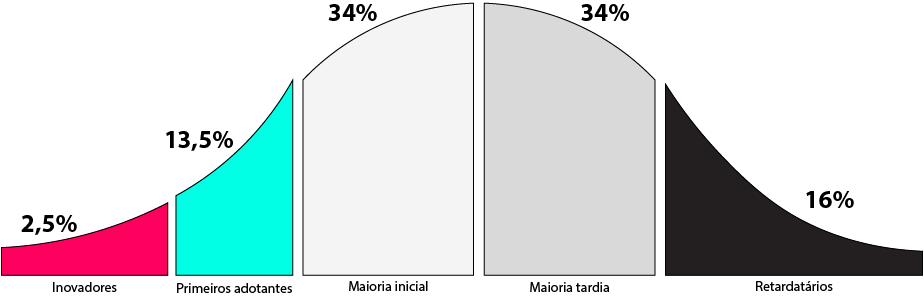
Rogers then identified five categories that indicate a predisposition to adopt innovations:
About 30 years after the first edition of *The Diffusion of Innovations*, consultant Geoffrey Moore published *Crossing the Chasm*. Revisiting Rogers’ work, Moore observed that, in markets for disruptive technology, the curve is not continuous. There are transitional gaps between the groups, and the one separating Early Adopters from the Early Majority is large enough to be classified as a “chasm”—and it is lethal to the adoption of innovations by companies.
The works of Rogers and Moore demonstrate that, although change exhibits “natural” behavior in companies, it is possible to manage it. The goal of change management is precisely to avoid the gaps and pitfalls involved in adopting innovations, enabling organizations to reap the benefits of new technologies as quickly as possible.
Given that the focus of this course is on the human dimension, change management projects will deal closely with organizational culture. In addition to analyzing the organization’s symbolic system, ethical assumptions, and behavioral logic, the change management team also examines the subjective, emotional dimension of organizational culture.
If we return to the characterization of the categories defined by Rogers, we will see that almost all of them are defined by adjectives. Innovators are curious and risk-takers; Early Adopters are leaders; the Early Majority is cautious; the Late Majority is conservative; and Laggards are averse to change. Looking at it another way, we can draw a “line of fear” between the extremes: on one end, the courageous innovators; on the other, the reluctant laggards.
It is precisely because we understand that change sometimes touches on deeply rooted emotions that the field of change management draws on an important tool from psychiatry: the Kübler-Ross change curve, or the stages of grief.
In 1969, psychiatrist Elizabeth Kübler-Ross published the book *On Death and Dying*, in which she analyzes the stages her patients went through to cope with and confront grief. In the book, Kübler-Ross proposed what would later become known as the Five Stages of Grief: denial; anger; bargaining; sadness; and acceptance and integration.
In the late 1980s, Cynthia Scott and Denis Jaffe, two psychologists, adapted the Kübler-Ross change curve in their book *Managing Organizational Change*. In the book, they argue that embracing an innovation represents the death of a reality as people knew it—and that is precisely why it is so difficult to accept it and, consequently, to open up to change. Scott and Jaffe condensed the five stages of grief into the four phases of organizational change: denial; resistance; exploration; and commitment.
Understanding transformation holistically—from both a human and a technological perspective—is essential to leading a change management project. Our AI Transformation unit leads this effort here at Inmetrics. Working alongside our clients, it redesigns roles, workflows, decision-making processes, metrics, and governance so that the interaction between humans and AI agents is focused on the organization’s growth. Get in touch and schedule a conversation with our experts. They’ll show you how to successfully achieve your company’s AI transformation.

