Retail
Black Friday: Are Your Systems Ready?

NRF 2026, the world's largest retail event, showed that the sector, in addition to new technologies, brought a new economic logic this year. What was previously treated as additions and specific improvements in performance and processes, such as investing in organized data and system stability, now determines the company's visibility, conversion, and margin.
Consumers have changed, decision intermediaries have also changed, and now systems are evaluated as an active part of the purchasing journey. In short: the impact is financial.

The main change seen during NRF 2026 is silent but has a major impact: in many simple journeys, it is no longer the consumer alone who decides. AI agents and assistants now mediate searches, compare prices, validate technical reputation, and even complete purchases.
And that profoundly changes the game: retail operations now need to be readable by these automated systems.
Outdated inventory, checkout instability, or price discrepancies between sales channels generate much more than customer frustration. These factors automatically exclude the company from the purchasing journey.
When an environment conveys unpredictability, it loses priority, which means losing revenue even before the competition takes place.
For years, efficiency was treated as an internal issue and obligation. Today, it appears directly in the perceived experience and brand exposure.
Traffic spikes should no longer be seen as exceptions. Seasonal dates, marketing campaigns, influencers, and paid media create constant fluctuations. Systems that cannot handle or struggle during these critical moments send a clear signal of risk.
The result: they are overlooked by AI agents because these recommendation systems do not tolerate risk.
Similarly, inconsistent or delayed data reduces technical reliability, which should no longer be just a brand slogan. It needs to be a priority and constantly optimized, as it is interpreted by protocols, APIs, and recommendation engines.
The impact of these operational changes is direct: more stable operations have greater revenue predictability, while fragile operations operate with squeezed margins and reduced visibility.
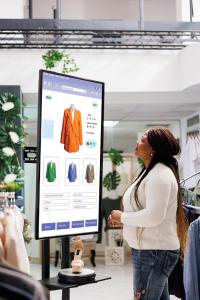
The physical store has returned to the center of the strategy, but with a different configuration. It is now an important part of the operational architecture.
Today, the store acts as a logistics hub, a micro-fulfillment point, and a customer experience space. Behind the scenes, it is a distribution center, and the showroom has become an environment for sensory connection and bond building.
This change requires total synchronization across channels. Inventory needs to reflect reality almost immediately, while return processes need to flow smoothly.
Any misalignment impacts not only the customer, but also the brand's eligibility in automated journeys.
Invisible payments, programmed limits, automated rules, and greater security requirements are factors that show that trust is no longer analyzed solely in terms of reputation, but has become a measurable operational attribute.
Recurring incidents, security breaches, instabilities, and an ungoverned cloud increase perceived risk and reduce exposure; in contrast, operations that invest in reliability, observability, and governance operate with less waste, less rework, and greater financial clarity.
As a result, we are seeing a structural change in operations: continuous quality and engineering focused on stability and performance have become essential elements of business strategy.
The latest technology alone is not enough to define today's retail industry. What will set companies apart in 2026 is operational consistency.
Real results in margin, predictability, and competitiveness are directly linked to the ability to sustain reliable environments, data integrity, and true integration across channels.
Those who see this change as just another cycle of digital transformation are missing the point. Today, architecture impacts revenue. Efficiency determines visibility. Quality defines permanence.
It is in this context that Change Makers in retail are beginning to stand out. They are leaders who treat engineering as part of their growth strategy, not as a support area. They are also executives who understand that technical stability protects margins and that operational predictability reduces structural risk.
Whereas previously decision-making power was concentrated in the hands of the customer, now systems also make decisions.
This is a structural change that is concrete and already underway. It is not a projection of the future or a conceptual trend.
Want to learn more about this topic? Check out the strategic material we have developed on retail in 2026 and the factors that are redefining competitiveness in the sector. Access it here.
If you enjoyed the content, be sure to share it with your network!
See you in the next post!

